
January is a time for vision boards
When I launched Maison Lafargue a few years ago, I faced the same mix of excitement and doubt that most founders feel when staring at a blank page.
I knew what I wanted to build. I didn’t yet know the universe I wanted to build around it.
What did success actually feel like?
Who was part of the long game?
What kind of life did this work need to support, not just professionally, but personally?
So I created a vision board.
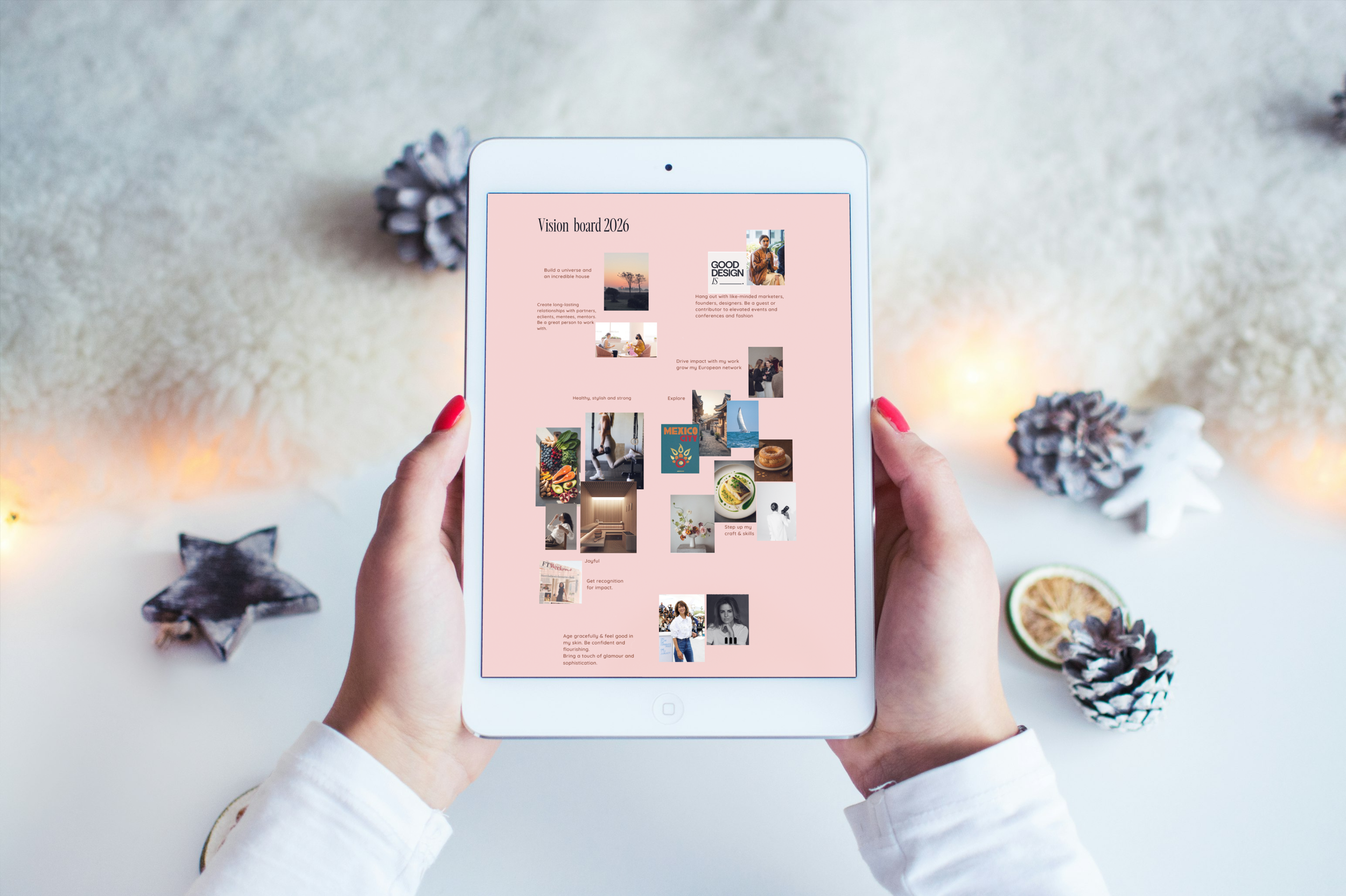
My 2026 vision board
It was powerful enough that I didn’t touch it for almost two years. It helped me guide some decision about where to allocate my time and who to hang out with.
This January, I revisited it, not to overhaul it, but to adjust it slightly. Because some of those visions had already become real!
If you’ve never made one, or if the idea feels vague or vaguely uncomfortable, this is for you.
What a vision board really is (and isn’t)
A vision board isn’t about “manifesting” things out of thin air. At its core, it’s a cognitive alignment tool.
Neuroscience has shown that our brains are far better at noticing, prioritizing, and acting on things we’ve clearly defined and visualized.
Ever notice how “for sale” signs seem to appear everywhere when you’re looking for a new place, but are almost invisible the rest of the time? That’s the idea.
When you articulate what you want, visually and emotionally, you change:
What you pay attention to
What you say yes to
What you believe you’re allowed to have
Entrepreneurs, athletes, and high performers have used visualization techniques for decades, not because they’re magical, but because they clarify direction and identity.
A vision board helps answer a deceptively simple question: What am I actually moving toward?
When a vision board is especially useful
There’s no “right” time, but these moments are particularly powerful:
At the beginning or end of a year, when reflection is already active
Before a career shift, new venture, or industry transition
When your priorities feel misaligned with your calendar
During a quarterly or seasonal reset
When you feel stuck
If you can’t articulate what you want next, it’s hard for the world (or yourself) to meet you halfway.
Step 1: Start with reflection, not images
Before opening Pinterest or Canva, ask yourself:
What currently gives me energy?
What feels heavy that shouldn’t?
What do I want more of, tangibly and emotionally?
What would “progress” look like a year from now?
Step 2: Define your categories
I recommend dividing your board into a few core dimensions.
Common categories that work well:
Personal growth: What energizes me? What am I learning?
Professional life: What does success actually look like for me?
Relationships: Who do I want to spend time with? How do I want those relationships to feel?
Impact: What kind of contribution do I want to make?
Financial life: What does “enough” mean to me?
Health & wellbeing: How do I want to feel in my body and mind?

Step 3: Choose images that feel specific
Whether you’re working physically or digitally (Canva works well), choose images that create an immediate internal response.
Not aspirational in an abstract way, but recognizable.
If you find yourself thinking: “That feels like me, but slightly ahead.” You’re on the right track.
How a vision board actually works over time
This is where many people get stuck, or dismiss the process entirely.
A vision board doesn’t “make things happen.” It updates your self-image.
When you repeatedly see yourself:
In a certain environment
Doing a certain kind of work
Surrounded by certain people
You start acting like someone for whom that future is normal.
Using your vision board in practice
A few principles that matter more than aesthetics:
Consistency: Glance at it regularly. Let it do its work in the background.
Flexibility: Update it. Remove what no longer resonates. Add nuance.
Action: Translate images into weekly or monthly actions, however small.
If you are looking for templates, Canva offers a wide selection that you can find here. We hope you will enjoy the process!