
Ali Abdaal, a former doctor turned productivity YouTuber and author of Feel-Good Productivity, spent a couple of hours on a Saturday afternoon with an AI tutor and ended up with a working home security system. He started with no knowledge of Linux, security cameras, or local AI models. He says facts struggle to stick without a real-world experience attached, and his 13 tips to Learn So Fast People Assume You’re Naturally Gifted (with AI).
Most of his 13 tips are habits good teachers have recommended for decades, like starting with a real project, following your curiosity, and spacing out your review. Three made me stop multitasking and start taking notes: teaching a topic through a world you already know and love, drawing the system, and arguing both sides. Each one below comes with a prompt you can paste today.
Borrow a world you already love
Most people already ask AI to “explain it like I’m 10,” which makes a topic simpler by stripping out the detail. A world you already love keeps the detail. You know its characters, rules, and places, so each new fact has somewhere to go.

Credit: J.L.
Ali picks Harry Potter and has the AI teach the new topic there. Ask about Linux, and Debian becomes the old Hogwarts: ancient, serious, and heavy on tradition. Ubuntu is the same castle with signs on every wall, a student handbook, and a customer support department, and the difference is hard to forget after that.
The prompt was a ramble he spoke out loud, with zero prompt engineering, and the analogy did all the teaching. Any world you know well works, whether it’s a favorite novel, a sport you play, or your own field. Then ask where the analogy breaks, because knowing that edge is part of knowing the topic.

Credit: Ted Lasso
Try it: “I’m getting my team ready for a big conference. Teach me how to motivate them through the world of Ted Lasso. Map what the BELIEVE sign, biscuits with the boss, and the Diamond Dogs look like for an event team, then tell me where the analogy breaks.”
Draw the system before you pitch it
For those of us who are visual learners, a picture is often what makes an idea click, and today’s models can write the code for an interactive diagram (HTML, SVG, or Mermaid) and render it right in the chat. Ask for the buying committee as a map, the sales cycle as a flow, or an investor’s logic as a diagram, and keep asking until the picture makes sense. Whoever can draw the system can explain it to a board.
Try it: “Draw an interactive map of an AI agent that writes a blog post, from concept to quality review. Show each step, what goes in and comes out, where the agent checks its own work, and where I approve before it moves on. Make each step clickable so I can see what happens inside it.”
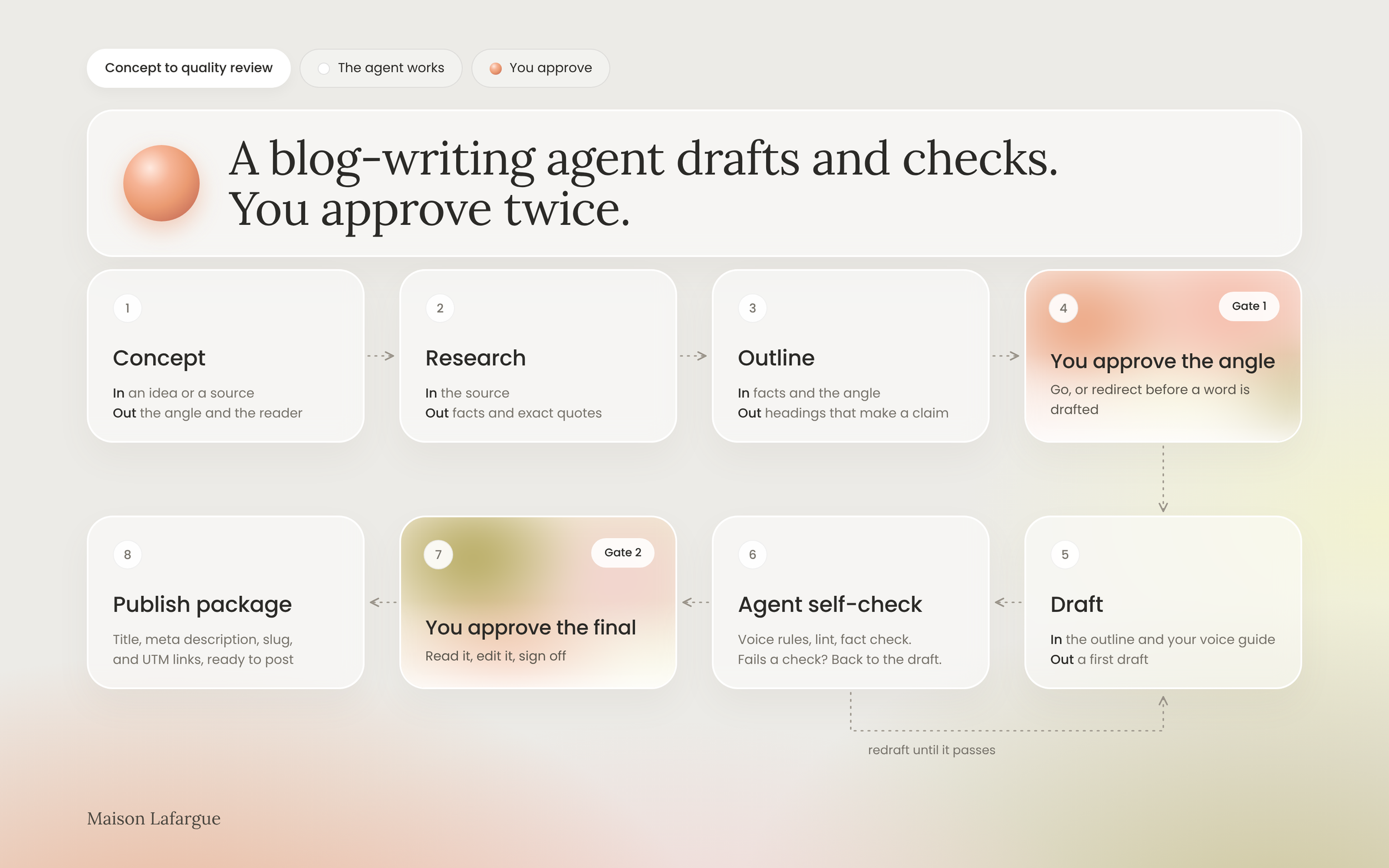
Made with Claude
The agent drafts and checks its own work, and you step in twice: once on the angle and once on the final post.
Practice arguing both sides
Controversy makes a topic memorable, because picking a side gives you a stake in the answer. Founders deal with debates like this all the time (build or buy, usage-based or per-seat pricing), and the buyer or investor across the table has usually already picked a side.
Try it: “Make the strongest case for using Claude as an AI coach for managers, then the strongest case for a purpose-built AI coaching tool, then the best rebuttal to each.” Write down which one you would pick and why, and ask the AI to attack your choice. Within 10 minutes you know the objection a buyer is most likely to raise, and you have an answer ready.
Fact-check harder when the stakes are high
AI still gets facts wrong, so check its answers in proportion to what a mistake would cost you. A wrong answer about a museum exhibit costs nothing. A wrong term sheet clause, SOC 2 requirement, or claim in a sales deck can cost you a deal, so confirm it with a primary source or a specialist before it reaches a contract, a buyer, or a board.
AI makes every one of these tricks cheap: the analogy, the map, and the debate. The learning still happens on your side of the screen, when you pick the world, question the map, and take a side. P
ick the one topic you most need to master this quarter, and try one prompt from this post on it this week.