Hire the AI first: surprising insights from a16z, Anthropic and Adobe
I advise AI-native startups on marketing, and I still feel FOMO about AI every day. So during SF Tech Week, I put a blunt question to three Schulich alumni: are we really behind?
David Borecky, Partner at Andreessen Horowitz, Sid Khare, Strategic Partnerships at Anthropic, and Sylvie Felx, former Director of GTM and Business Operations at Adobe, answered, with Murat Kristal, Program Director of the MBA in Technology Leadership at Schulich, keeping everyone honest.
Go first
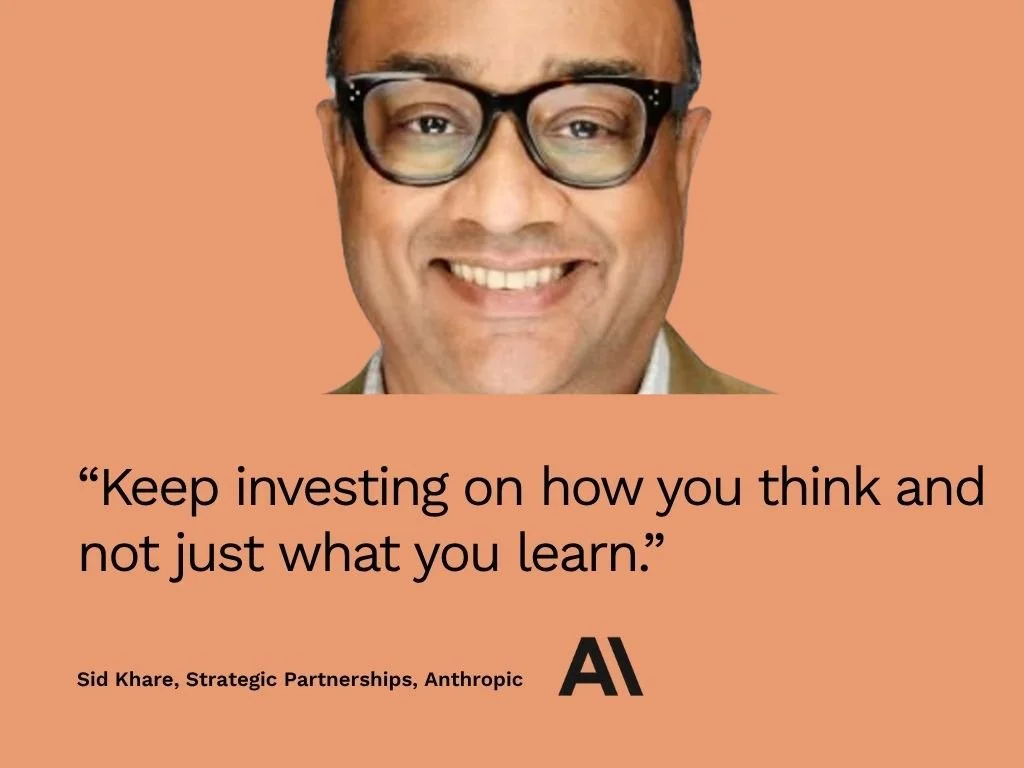
Sid Khare is a strategic partnerships leader at Anthropic, and the partners he works with include some of the biggest consulting and systems integration firms in the world, the companies that were supposed to lose the most to AI. His answer started with a flat reassurance: “your job is not going away.” The predicted wipeout of services jobs is “not playing out as it had been predicted.” One partner reported quarterly revenue about 6 percent above the top of its guidance and told investors “AI was a tailwind driving those revenues.”
The explanation is that Anthropic’s partners are “the largest customer zero for our technology.” They use Claude across more than 300,000 of their own employees, which gives them “a defensible moat” and, in front of a client, “a real-world proof point.”
Sylvie Felx spent twenty years at Adobe, most recently running go-to-market and business operations for its enterprise AI products, which meant convincing large companies to spend millions on something new. Her rule was the same: “we’re not going to sell a product if we cannot talk by experience.”
Inside the finance team of an AI-native startup
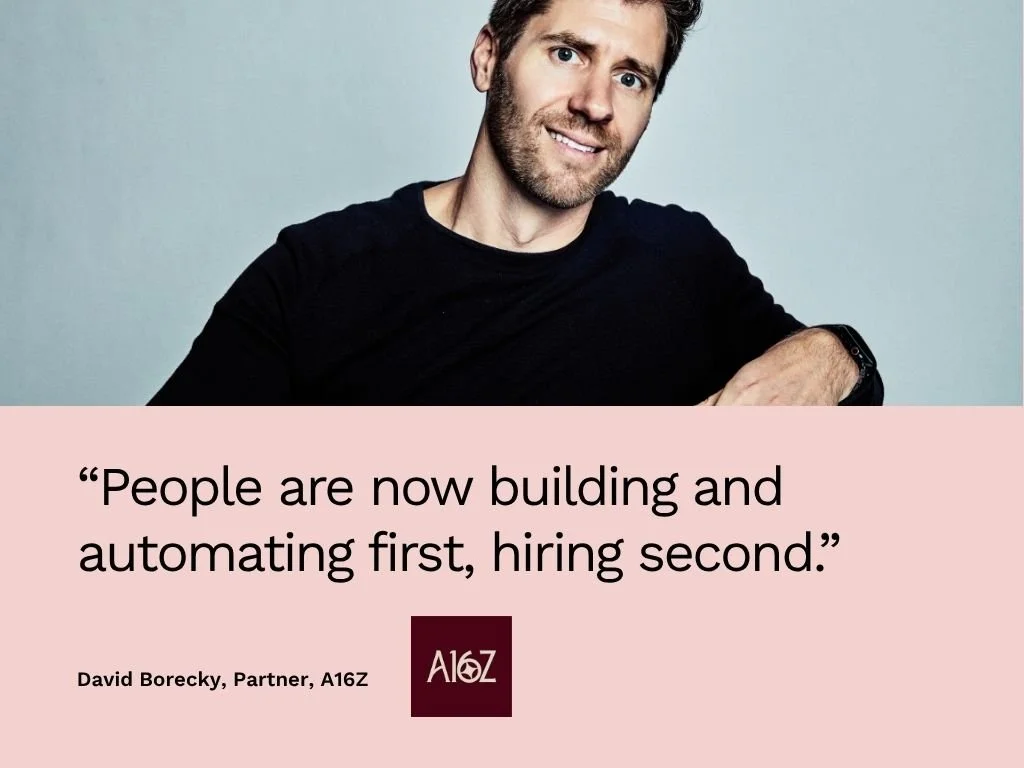
David Borecky, a partner at Andreessen Horowitz, helps early-stage founders build their finance functions. “It’s an exciting time to be doing this,” he said, and he described a team that works differently from day one. The leader he looks for is a finance engineer, someone who embraces AI and layers deep knowledge of process on top of the tools. “People are now building and automating first, hiring second,” he said, which flips the old habit of hiring a crowd first and automating later. The books close in a day, so “always be closing isn’t now just for the salespeople.” He names all his agents, and “they all have different personalities.”
What David likes most is what the work frees people to do. The parts people enjoy are creating value, working with the business and unlocking new opportunities. “It’s not trying to reconcile a bank statement.”
Finance teams that spent ten years waiting for engineers to build their reporting tools now build them with AI themselves, and he calls it “a massive unlock,” because they are no longer “stage gated by a dependency on some other team.”
Ride the speed
“Six months at Anthropic feels like six years anywhere else,” Sid said, and the pace is “unlike anything I’ve seen in my career.” In three weeks the company shipped two models within six days of each other, announced a $100 million program to train 10,000 frontier deployed engineers by the end of 2027, and released a feature that lets Claude work with Google documents and slides. I could see people in the chat saying they loved the new features, and one wrote that a feature “automated all my charts in gsheets.”
Sylvie watched Adobe go from releases once a year to daily. Murat Kristal, who directs Schulich’s MBA in Technology Leadership and researches digital transformation, tells the happiest version. AI gave him no extra time, because “I feel like I can do even more stuff, and I cannot help myself.” His verdict on writing his own cases and grading rubrics with AI: “it’s making it more fun for me.”
Start with a pen and paper
All four panelists gave the same warning. Sid: “you can’t take an existing process, just sprinkle AI on top of it and expect it to start performing well.” You have to understand the process and the business metrics, and “you do not need to become a machine learning engineer” to do that. Murat’s version: “go back to the basics... and have a pen and paper to visualize how everything is working in an organization.” Sylvie’s buyers, signing multimillion-dollar deals, told her, “It’s not the technology. How we’re going to manage that change with AI.”
Keep one call for yourself
David watched his Tesla go from stopping randomly in the street to a car where “I literally don’t touch it until then.” He still would never let an agent write a public company’s annual filing and send it to regulators, which “would definitely be a career-limiting move.” Sid’s rule is the same in his own work. He uses Claude as “a very smart chief of staff” whose job is to supply the data, and “that call is mine.” The one decision he will never hand over is the personal conversation with a partner or client, because “partnership skills still run on relationships and not on algorithms or agents.”
Show the math
“Deploying AI wall-to-wall can get expensive very quickly if you don’t know what you’re doing,” Sid said, and “a token bill that leadership cannot tie value to is a real big problem.” His answer is usage tracking built into the products, so customers can build dashboards that connect spend to business results, plus matching the model to the job. List prices differ tenfold between Anthropic’s cheapest and most expensive models, and a customer service chatbot does not need the one that modernizes a mainframe. The partners “become the translation layer” to the executives who sign off, and Sid calls that work “value engineering and not AI engineering.”
Invest an hour a day
None of these careers followed a straight line. David took a sabbatical after twenty years as an operator to find out what he was passionate about. Sid has reinvented himself across five countries and took an executive MBA fifteen years into his career: “once your thinking has changed, your brain doesn’t really fit back into its old mold.” Sylvie went back for an MBA after six or seven years of work and called it the “best investment in my life.”
Their advice fits on a card. David: “there’s never been a better time to learn about literally anything,” so spend an hour or two a day with the newest tools, many about $10 a month, one of which “could potentially save you hundreds of hours.” Sid: “AI will elevate your job, not replace you.” Sylvie: “Understand what you want to achieve, what is your goal, your purpose, and then focus.” Murat: learn why the formulas exist, and “you’re going to catapult your career.”
If you feel behind
I started the hour with FOMO and ended it with a short list. Spend an hour or two this week with one tool that costs about $20 a month. Hand one of your own tasks to it before you ask your team to do the same. Draw the process on paper first, so you know what the tool is replacing.
This was such a great conversation. My key takeaways? AI is changing how we work every day, so invest in your thinking, be purposeful, go deep in topics you care about so you can create your own moat.