
Sustainable design as foundation for a better life
At SF Climate Week 2026, Llisa Demetrios, Chief Curator of the Eames Institute and youngest grandchild of Ray and Charles Eames, opened the afternoon with something that had little to do with furniture.
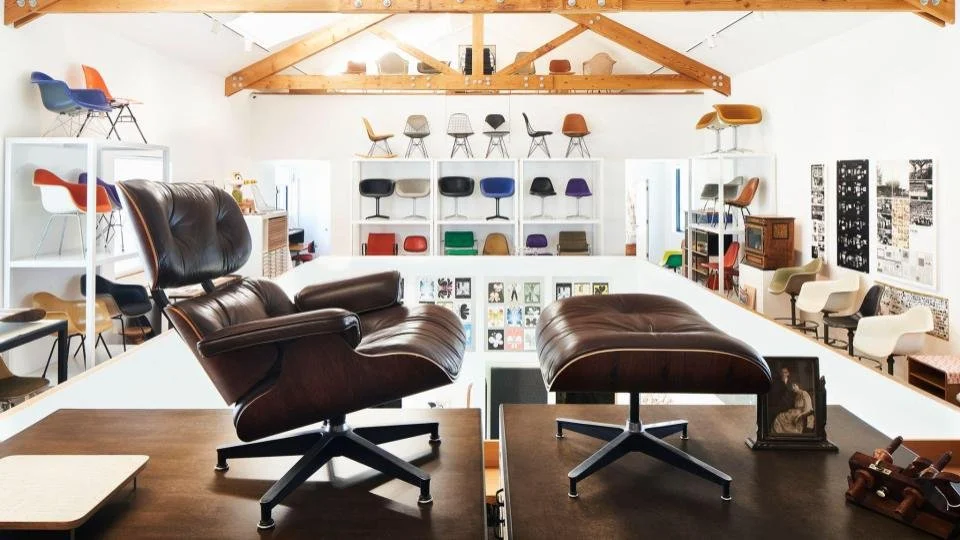
Llisa Demetrios, Chief Curator of the Eames Institute of Infinite Curiosity and youngest grandchild of Ray and Charles Eames, has about 50,000 objects to curate. The archive in Richmond includes 750,000 slides, images, and prints, furniture prototypes across four decades, graphics, films, toys, and the kind of drawer where someone has written "do not use these papers without asking Ray."
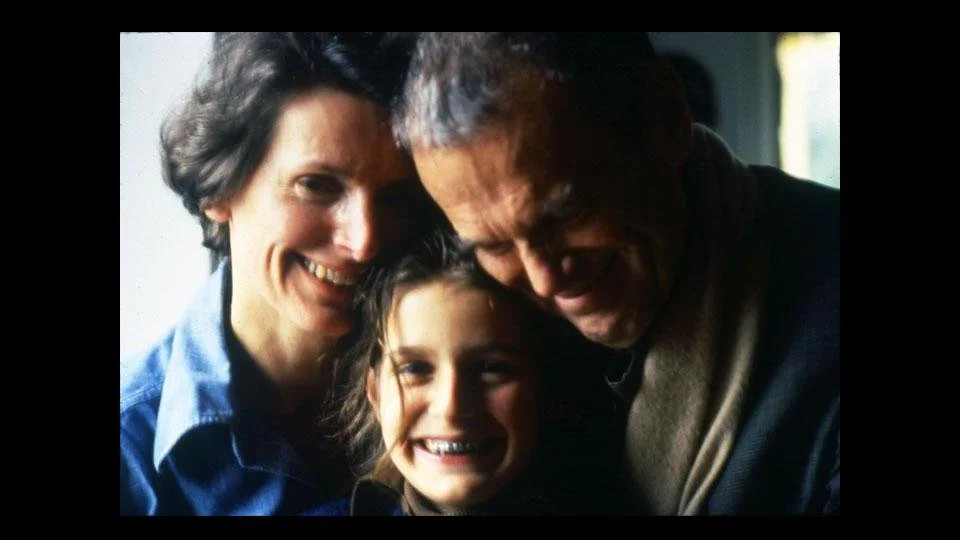
Credit: Eames Institute. Llisa with her grandparents
What she came to share was a method. And it maps almost exactly onto the problems everyone in the room was trying to solve.
Draw the brief wider than you think
When Ray and Charles were asked to design airport seating, their first question was: what's wrong with what already exists? They went and talked to maintenance teams at four airports. The answer wasn't comfort. It was replacement parts. The seat and back were different shapes, heavily upholstered, and it took three people to swap one out. Ray and Charles made both pieces the same shape so the whole thing could roll into a tube, be removed by one person with one screwdriver, and stored in a fraction of the space. That's why airport seating lasts.
They had already learned this the hard way. An earlier chair designed with Eero Saarinen was installed and immediately revealed the problem: they had only been thinking about the person watching a performance. The person who had to take care of the chair had never entered the brief. "The role of the designer," they said afterward, "is that of a very good, thoughtful host, anticipating the needs of his guests." Every guest. Including the ones who clean up after the show.
Credit: Eames Institute
For anyone building a product today: who isn't in the room when you're defining the brief? The staff member, the maintenance team, the person at the end of the supply chain are the reason products either last or don't.
You don't want to make it once
Ray and Charles never wanted to make a chair. They wanted to figure out how to make it 100,000 times. That distinction shaped every decision: material choices, manufacturing partnerships, the testing protocols they built into Herman Miller that still give the company its longest guarantees today.
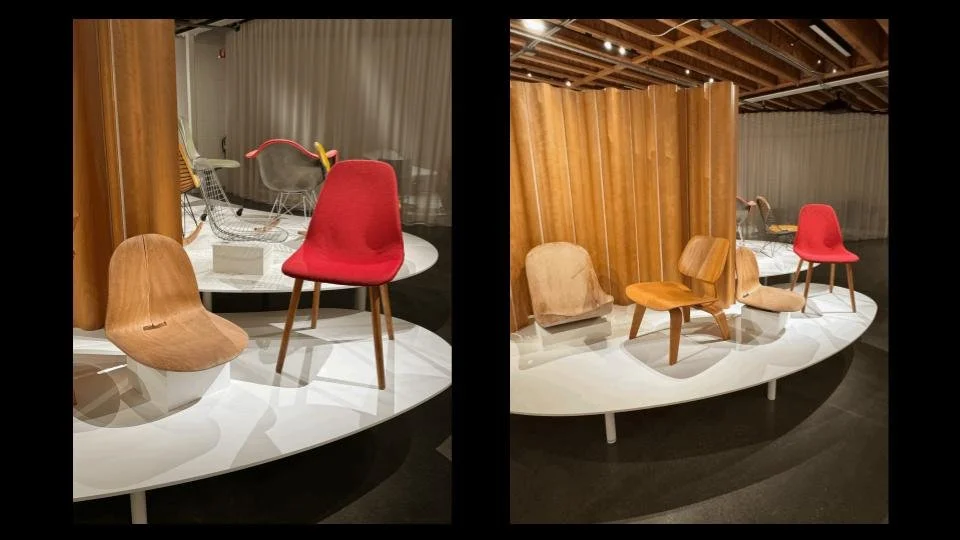
The iteration was just as deliberate. Two early versions of the DAX chair sat side by side during Llisa's presentation. The difference was a cloth edge versus a rubberized one. The cloth version wore out and people threw away the upholstery. The fix came from the observation. When a craftsman who had made seven aluminum prototypes was told Ray and Charles wanted the first one, he pushed back. "I have six more." Their answer: "Because you made the other six, we know the first one is right."
For founders: the prototype you're proud of exists because of all the ones that didn't work. That's the proof, not a footnote.
Credit: Eames Institute
Goodness all the way down
In 1969, when asked to explain their design process for an exhibit, most participants wrote a few paragraphs. Ray and Charles drew overlapping circles. Their office. The client. Society as a whole. The work had to live where all three overlapped.
With Herman Miller they extended it to five: good for the company, good for the person on the line making the furniture, good for the designer, good for the community, good for the environment. "Goodness all the way down," Demetrios said. A constraint applied at every step, not a values statement on a wall.
Ray discontinued Brazilian rosewood on the lounge chair as soon as she understood what harvesting it cost the forest. It then took 20 years for Herman Miller and Vitra to find palisander as an appropriate alternative. She waited. That's what a material commitment actually looks like at the pace of industry.
Don't be afraid of where the next idea leads
The leg splint came from a conversation at a party in 1943. A friend mentioned that metal splints were making soldiers' wounds worse. Ray and Charles had been married two years and were deep in furniture development, having just figured out how to work with plywood. They applied what they knew to a problem they hadn't anticipated. By 1943, 100,000 wooden leg splints had been made for the Navy, a contribution to the war effort, as Demetrios put it, "without hurting anybody."
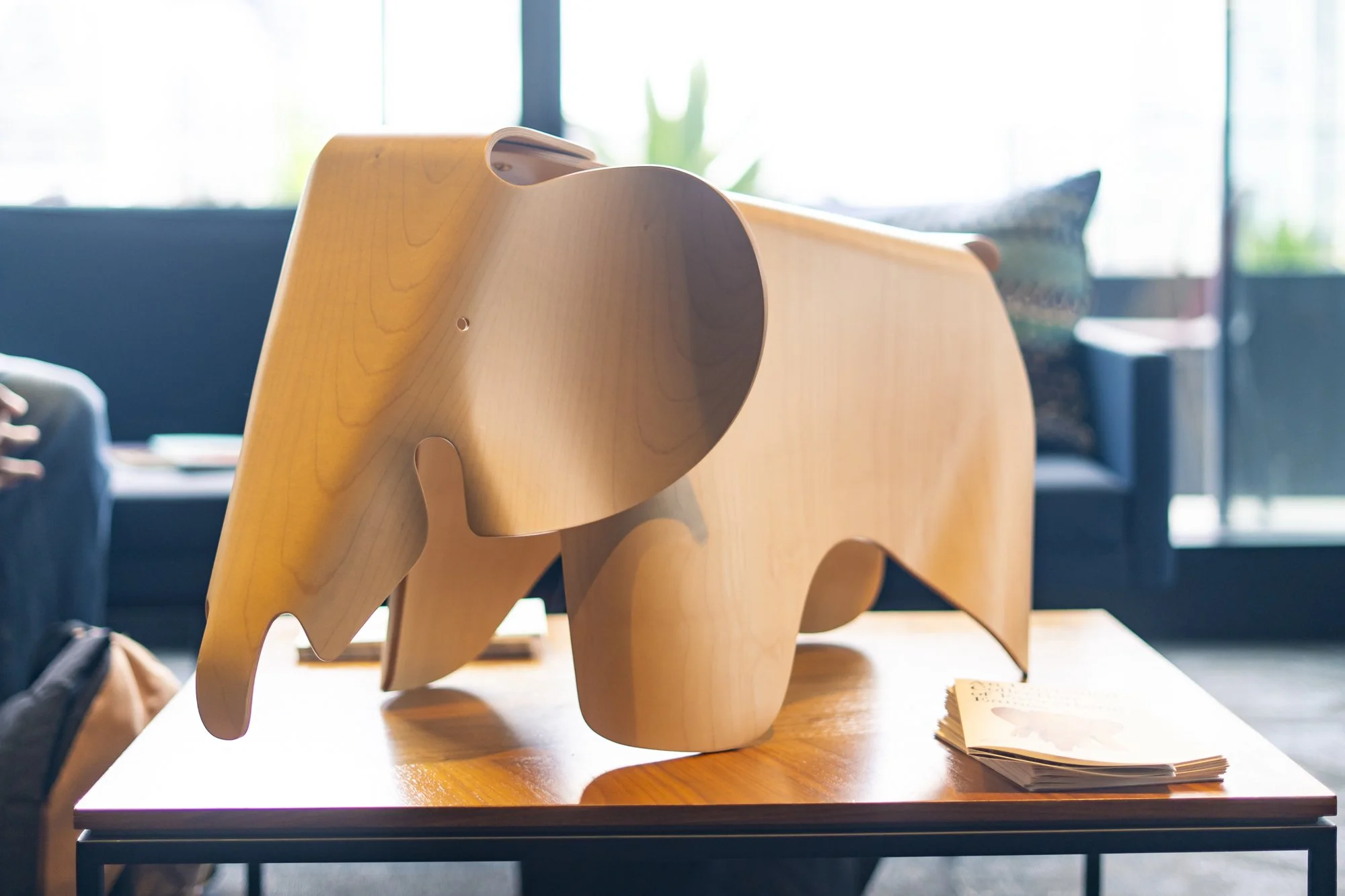
The splint led back to children's furniture, which led to the elephant, a piece so technically complex it was not mass-produced until after both of them had died because the technology had not yet caught up. The aquarium proposal that Nixon cancelled became a booklet that informed both the Monterey Bay Aquarium and the Baltimore Aquarium. The solar toy Alcoa commissioned, which "does absolutely nothing fabulously," was built to introduce the idea that alternatives to fossil fuels exist, through play rather than instruction.
Every project was part of a chain. "The most important thing is that you love what you're doing," Demetrios said, "and the second, that you're not afraid of where your next idea will lead."
For a room full of people building climate companies: the work you're doing right now is probably not the last form it will take. The constraint is staying curious about where it goes next.
Take your pleasure seriously
Ray and Charles collected 200 boxes of toys. They treated them as research. As they traveled the world, two toys kept appearing everywhere they went: kites and tops. "They're so well-designed," Demetrios said, "you forgot they were designed." The tops lived in almost every room at the office because they were perfect icebreakers with people from anywhere in the world. No language needed.
"Toys and games are preludes to serious ideas" was how they put it. The solar toy that does absolutely nothing fabulously was a Trojan horse for climate. The circus mirrors installed every few benches at the IBM Pavilion were there so children could make faces at themselves while their parents figured out where to go next. Delight was a design tool, built into the work from the start.
For anyone building something people actually have to want to use: joy is often the reason adoption happens at all.
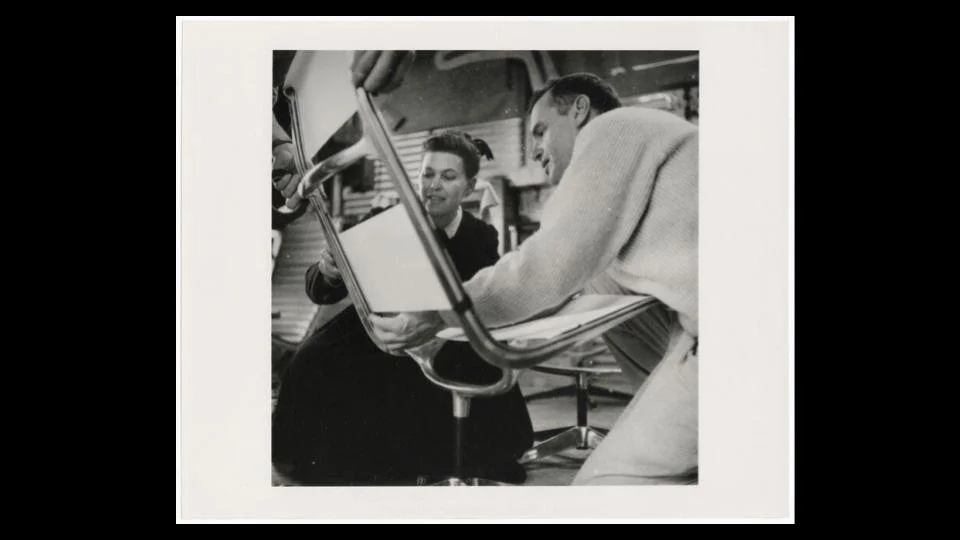
Credit: Eames Institute. Charles and Ray.