
The new shape of startups

The lean team era is here.
At the 2026 Charter AI Summit in San Francisco, Kevin Delaney made an observation that got me thinking. Silicon Valley's most ambitious CEOs aren't talking about headcount as a signal of momentum anymore. They're talking about getting back to ten people arguing over product at 2 a.m., a team that feels more like a friends group than a company.
What looked like an efficiency trend turned out to carry something deeper: a cultural aspiration.
Yes, the early days carry a specific energy: decisions made fast, everyone close to the product, no coordination overhead. The best founders remember that period as the one where they felt most alive inside the work. Staying lean is, in part, an attempt to protect that feeling as the company scales, and AI is making it feel more achievable than ever.
The minimum viable team.
AI genuinely compresses the marginal cost of execution. Founders who once needed a full marketing pod can now deploy agents for research, content, and campaign iteration. Engineering teams ship faster with copilots and automated testing. Customer insights surface from transcripts in hours instead of weeks.
It also becomes a badge of honor for larger companies: According to Layoffs.fyi, 124,201 tech employees were laid off across 271 companies in 2025, with another 34,650 already gone in early 2026. A significant portion of that reflects a belated recognition that many operating models were overbuilt relative to the leverage now available through AI.
Founders who want to stay small and can resist the psychological pull of over-raising, and think about financing scale differently.
Rethinking funding options
“Funding announcements from others are an intentional distraction. Growth VC comes with an explicit promise that raising large rounds is part of a psychological game in which the announcement is meant to demoralize competition and suggest that VCs have picked a winner. “ Third Sphere.
For years, a large funding announcement implied category leadership before that leadership was earned.
But with AI and lean teams, The badge of honor shifts from dollars raised to dollars earned.
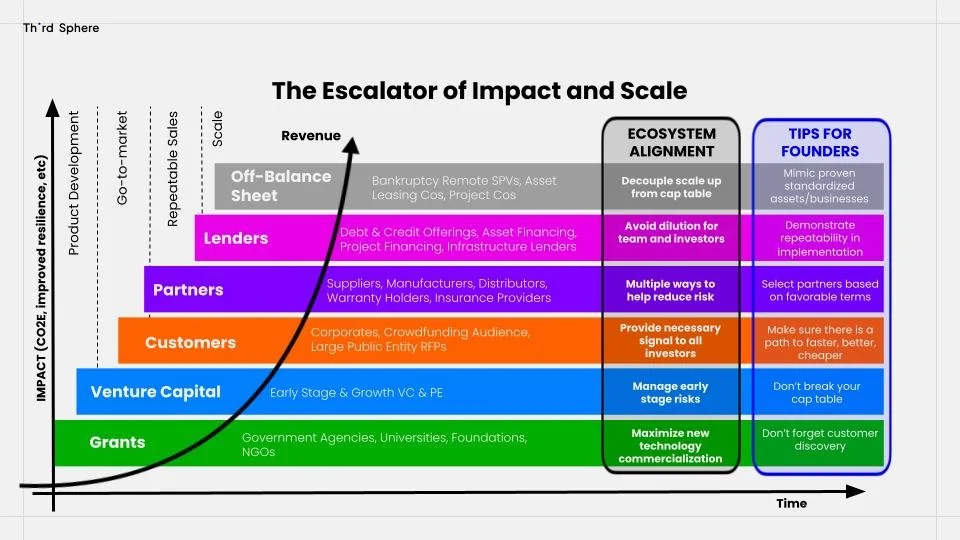
Credit: Third Sphere, from the Speedstrapping playbook for climate tech founders.
Third Sphere's speedstrapping approach reframes venture capital as one lever among many. The emphasis moves toward early revenue, disciplined burn, and growth that compounds.
The investment firm focused on climate startups has a clear thesis: Speedstrapping should be Plan A, not Plan B.
Instead of raising successive large equity rounds and optimizing for growth VC, founders should:
Raise minimal early equity (pre-seed/seed)
Generate revenue as early as possible
Use AI to stay lean
Layer in non-dilutive capital (private credit, revenue-based finance, customer prepayments, grants, asset financing)

Credit: a16z Speedrun
Troy Kirwin Investment Partner at a16z reinforced the broader pattern in their 2026 Big Ideas: as AI compresses execution costs and accelerates paths to durable revenue, capital is beginning to follow operational strength and margin quality rather than growth velocity alone.
AI changes the economics.
As labor becomes software-augmented and automation moves from reporting to execution, these historically PE-owned categories become structurally attractive for venture-backed companies. The total addressable market expands because value shifts from cost tracking to work completion. Margin expansion becomes a design lever rather than a byproduct.
Three collision points are emerging.
First, private equity funds increasingly act as distribution channels. Many have made AI adoption a portfolio-wide priority and hired central leaders to oversee implementation. For AI startups, this creates concentrated access to dozens of operating companies at once. Selling into a PE portfolio means scaling across a controlled network rather than winning logos one by one.
Second, PE portfolio pages function as category maps. Private equity firms often acquire vertical software businesses whose TAM constrained venture returns in earlier eras. As software evolves into AI agents that take action and execute workflows, those same vertical categories expand. Founders can identify legacy incumbents backed by private equity and design AI-native systems that unlock new margin layers within those sectors.
Third, AI rollups accelerate the convergence. Venture-backed AI platforms are acquiring legacy services businesses, often using debt to finance transactions, then integrating automation deeply into operations. The thesis centers on doubling margin through AI-native workflows and owning the value chain end to end. Agent Astra, a Speedrun company, provides a clear example by acquiring freight forwarding services and embedding AI throughout the operation to transform cost structure and throughput.
The” full-stack” founder expectation
Doing more with less is putting pressure on everyone.
When the team is small and AI handles a growing share of execution, the founder becomes the company's primary source of judgment across many function. Top salesperson. Brand voice. Product designer. Narrative architect. AI systems operator. Talent magnet.
Recent interviews on Lenny’s podcast have referred to the productivity paradox. AI saves you time generating content, but then creates new work reviewing it. In a survey Lenny ran with about 1,750 tech workers, finds that founders us AI heavily for productivity and decision support (32.9%), product ideation (19.6%), and vision/strategy (19.1%).
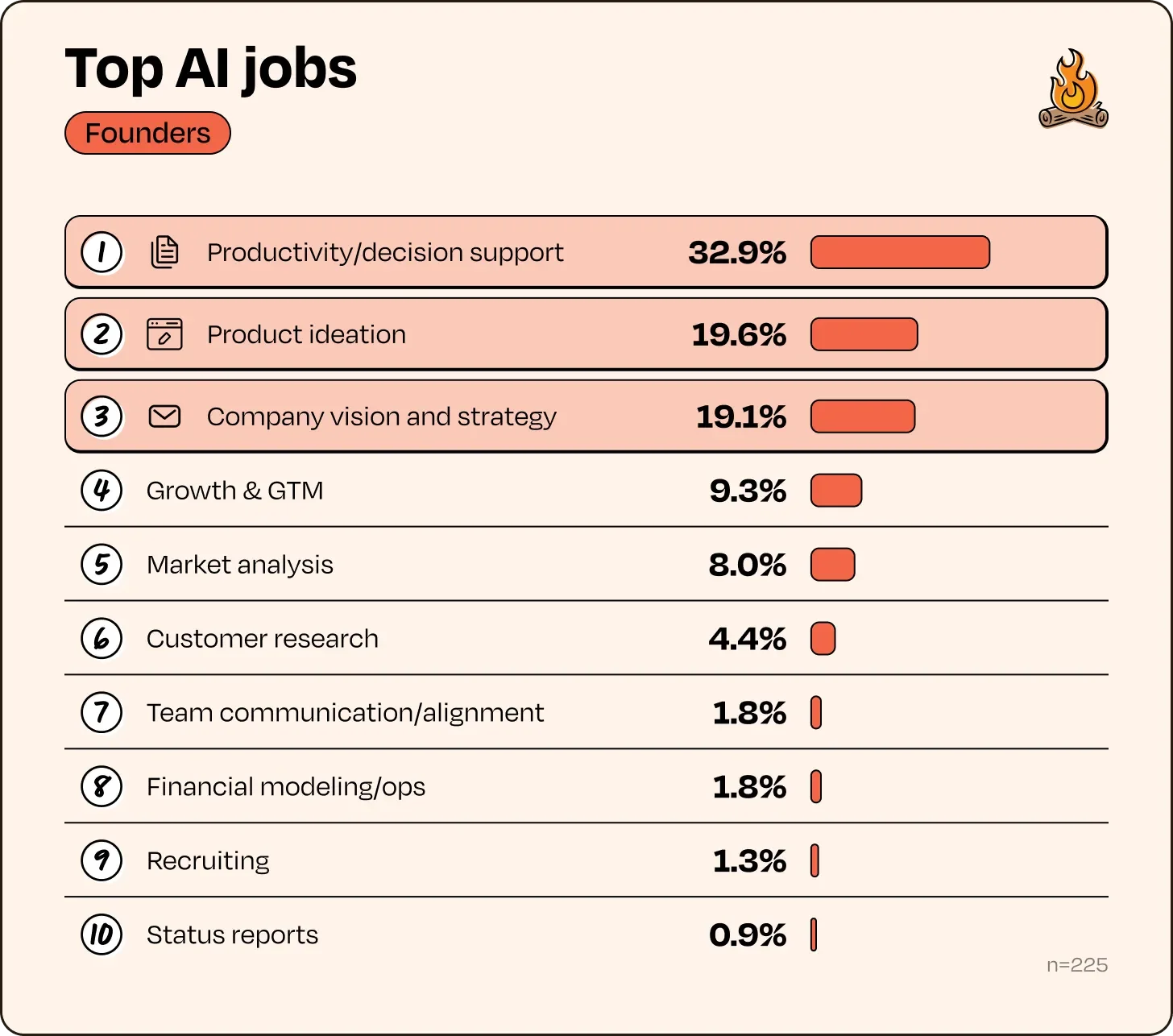
Credit: Lenny’s newsletter
AI raises the ceiling on what a lean team can produce. Content, code, campaigns, customer research: all of it scales faster and cheaper than ever before. But output at scale without strategic foundations produces volume. And volume without positioning, without a coherent brand, without a repeatable sales narrative, becomes empty calories quickly.
The point that often gets missed is that AI makes weak foundations more expensive to ignore. A founder producing content at ten times the speed with no clear positioning has a positioning problem running at scale.
Lovable crossed $100M ARR eight months after their first $1M. That kind of velocity comes from a company that knew exactly who it was building for and why that mattered before the growth started.
Their mission is worth reading carefully: "For decades, software has been the most powerful way to turn ambition into reality, yet fewer than 1% of people have had the skills or access to build it. We're changing that." That's a positioning statement as much as a purpose statement. It names the problem, identifies the excluded majority, and plants a flag around democratization before the product does the talking.
Building the foundations to grow fast
As a marketing advisor working with founders at this stage, the pattern I see most often is a team that has invested heavily in AI tools and lightly in the foundations that makes those tools useful. Or worse, startups try to copy models and prompts designed for other PMF stages, industry or sales motions.
The most effective lean teams I work with bring in senior operators to build the systems first, then use AI to run them. A founder who doesn't yet need a full-time head of marketing can still engage someone with the experience and taste to design a marketing architecture that a lean team and a set of agents can execute at scale. What changes is the nature of the engagement. Shorter, more focused, oriented around building something durable rather than managing ongoing execution.
The economics work differently too. A fractional or project-based relationship with a senior operator costs a fraction of a full-time hire and produces the structural clarity that makes every subsequent execution decision easier and faster. The AI handles the volume. The experienced operator ensures that volume is pointed in the right direction.
What this looks like as an operating model.
A practical way to frame it is through three questions.
What are the foundations that only judgment and experience can build? Positioning, narrative architecture, brand voice, talent philosophy. These require taste and pattern recognition that comes from having done it before in contexts where the stakes were real.
What are the systems that translate those foundations into repeatable execution? A synthetic marketing function built on AI agents. A sales narrative any team member can run consistently. A metrics dashboard that surfaces friction before it becomes churn.
What does AI accelerate once those systems exist? Distribution, content, research, iteration. The compounding advantages lean teams need to compete with larger, slower-moving incumbents.
When those three layers are aligned, staying lean becomes a genuine structural advantage. When the second and third layers exist without the first, output is high and traction is inconsistent. That's the pattern behind most enterprise pipeline problems at the seed-to-Series A stage: good product, capable team, and foundations that were never quite built.
Building for the era you're actually in.
The founders who convert efficiency into enterprise momentum treat their operating system with the same rigor as their product. They design narrative intentionally. They structure go-to-market choices deliberately. They deploy AI as infrastructure rather than as scattered experiments. They align metrics with story before the board asks for it.
That discipline compounds.
If you are building with a lean team and feeling the pressure to move faster without spreading thin, we are hosting a focused session on how to do this deliberately.
Join us for The full-stack founder: AI-powered go-to-market systems for lean teams, a free 60-minute workshop where we break down:
Narrative architecture that enterprise buyers can repeat
AI-agent foundations that extend your marketing capacity
How to sequence GTM channels and investments for maximum leverageThe full-stack founder: building leverage with AI. RSVP here.